Showing posts with label Counter Trafficking. Show all posts
Friday, November 23, 2012 0 comments

Traffick Jam - Part 2

Last Friday, two of my 11th graders - Dasha and Vitalik conducted their own training on human trafficking with a group of 15 students from the 8th grade as part of our school's human trafficking awareness week. Dasha and Vitalik attended the "Traffick Jam" counter human trafficking training with me in Kharkiv last month, and I'm proud to say that they learned enough there to be able to teach a lesson on human trafficking by themselves!

A group photo with 527 pamphlets and the class certificates.
with Dasha and Vitalik (in my teal suede shoes).
Dasha and Vitalik prepared for this lesson for 2 weeks with Ira Ivanovna, our school psychologist. For the most part, the 8th graders were attentive and the girls were more active then I expected. Personally, I don't like teaching lessons to 8th graders because they don't listen to me (since I'm young for a teacher) and rather play on their cell phones.

Vitalik starting off the lesson by asking the students what do they know about human trafficking. 
Ira explaining that human trafficking is more than sexual exploitation. 
 After covering the basics about human trafficking, Dasha and Vitalik discussed some facts related to human trafficking in Ukraine. For example, Ukraine is not only an origin point - it is also a destination and transit point. Not very many of the 8th graders knew this, so its a good thing that we had this training (otherwise they may never have been made aware of the dangers of human trafficking).

Listening to the 8th graders compare their answers about who are the traffickers. 
Dasha explaining the task - the students had to label a pie chart with their guesses as to which countries Ukrainians are trafficked to. 
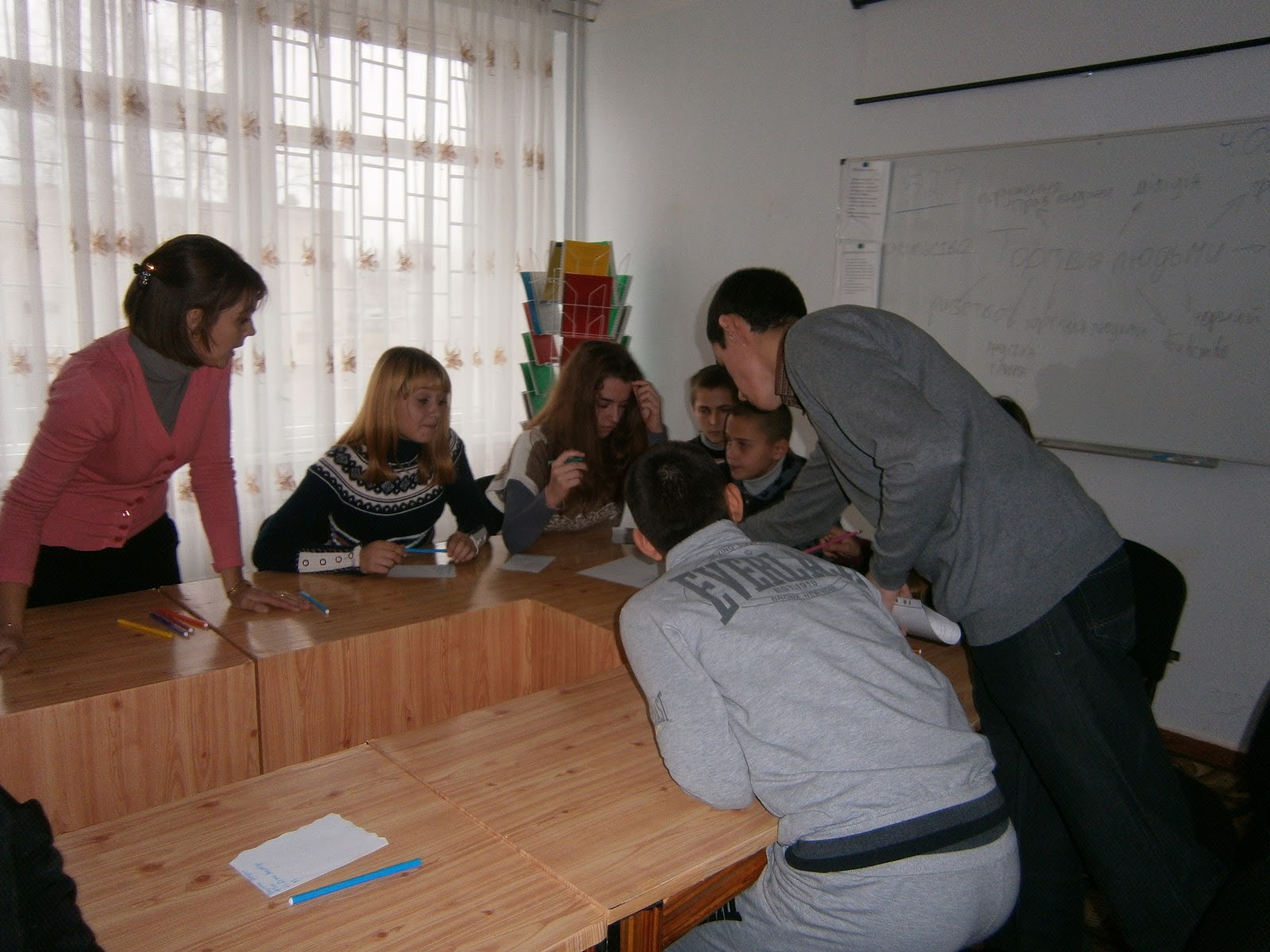
The kids working together to brainstorm where traffickers can find potential victims. 
Tanya sharing her group's answers with the class. 
The group debating over different statistics.
Vitalik explaining the statistics to the students. 
Even though this was only a short training on the basics of human trafficking, I'm grateful for two things: the first is that Dasha and Vitalik had the chance to conduct their own lesson and the second is that the 8th graders seemed actually interested in what we were talking about. Before this training  I was worried about how they would respond to this topic since it can sometimes be a little controversial among Ukrainians - not all Ukrainians believe that human trafficking is a problem in Ukraine, and I'm glad that we taught our students to believe otherwise!

Great job Dasha and Vitalik!
Thursday, October 11, 2012 0 comments

Traffic Jam: Stop Human Trafficking!

Last weekend, I worked with a few Ukrainian friends to organize a counter human trafficking project called "Traffic Jam". The 3 Ukrainian organizers - Alla, Platon and Vova are students who participated in Camp CACTUS last summer - a leadership camp in Ternopil, focused on organizing community and social development projects. They did most of the work planning the project such as recruiting participants, making the seminar schedule, and all I did was help them find trainers and a place to hold the seminar. We organized a 2-day seminar as a training of trainers about human trafficking at the American Center in downtown Kharkiv.

Traffic Jam Seminar participants and organizers!
The group of 3 students was granted a mini-grant from CACTUS to fund the seminar. CACTUS is a camp organized by Peace Corps Volunteers but it is also funded in part by FLEX grants - my friend Roma wrote a grant last year, and he was granted funding for the camp. FLEX stands for Future Leaders Exchange, and its a very well-known program here because they offer full scholarships to 9th-11th grade Ukrainian students to study in America for 1 school year.

We started the seminar with this self-assessment exercise: "my opinion about the topic counter human trafficking", and we were excited to see that most of our participants were interested and wanted to know more about the topic.
We played "Lions and Trees", an American-style icebreaker where people basically just run away crazily from lions and toward trees. 
Our first trainer was a lady from the Kharkiv ministry of human rights and human trafficking. She gave a very long and thorough presentation in Ukrainian. I'm only pointing that fact out (that she spoke Ukrainian) because most people speak pretty clean Russian in Kharkiv. Kharkiv is very close to the Russian border and a lot of people who live in Kharkiv either have Russian roots or travel frequently to Russia.
After some technical difficulties, we finally got the projector to work. 
The participants divided into groups to brainstorm how human trafficking affects peoples lives - not just the lives of victims but their families and others as well.
The second trainer that we had was a former police officer. It was interesting to hear his point of view, from someone who has experience with trying to catch traffickers and other criminals. He also asked me to compare the American justice system with the Ukrainian system - like how our police can ask someone to wear a wire and secretly record conversations, which hold up in court as evidence. Apparently this isn't legal in Ukraine, and he thought that our system worked much more effectively than Ukraine's. However, the conversation started to get over my level of Russian knowledge (since these are specific legal and police terms that I didn't know) and it got heated really fast when he made some statements that contradicted with our participants point of view and they were shocked.

The third trainer that we had was phenomenal... his name was Ivan Budko and he was a charismatic and enthusiastic young man who came to train our participants on public speaking. His training was by far the best training that I've ever seen done by a Ukrainian - it was super professional and yet active and engaging with the communicative method.  This topic is unusual for professional development in Ukraine, even though its become almost an expected topic at American professional development seminars. Just like Americans, many Ukrainians are terrified of giving public speeches. Not very many of our participants had experience with public speaking, and I think that they learned a lot of techniques from our trainer like how to relax before giving a presentation, preparing your speech to fit your audience, scanning the room and eye contact (a big one for Ukrainians!), how to use appropriate hand gestures, and how to capture your audience by doing small things like adjusting your emotions and the volume of your voice. If you'd like to invite him as a trainer to your next seminar or conference, you can find out more information on his website at http://ivanbudko.com/ (which is in Russian but he speaks English fluently).

Ivan explaining the breakdown of a public presentation into its components; 20-60-20 by percentages of warm-up/introduction, main body and conclusion/call to action. 
Warming up by making funny humming noises with vowels. 
We ended the seminar by asking the participants to practice giving short presentations using my "527" powerpoint slides. This was the presentation from when I conducted a "527" seminar in fall 2011 as part of the Gender and Development's nationwide counter trafficking awareness project - where Peace Corps Volunteers from every oblast participated in training Ukrainians and filming public service announcement videos. The goal of the 2-day Traffic Jam seminar was to train our participants well enough that they would be able to go back to their schools and communities and conduct human trafficking lessons on their own. I brought 2 of my 11th form students with me to the seminar, Dasha and Vitaly, and we will conduct a counter human trafficking lesson for the 8th graders in our school. Dasha attended Camp H.E.A.L. with me last summer, so she already has had some lessons about human trafficking and she also participated in the 527 awareness campaign that we did on the beaches of Sergeevka, Odesska Oblast : )

Vitaly and his partner presenting about the education levels of trafficking victims... over half of them have a university or college education - these are the people most likely to search for jobs outside of Ukraine. 
Dasha presenting about 527 - the national hotline where Ukrainians can call to check if job/travel/study abroad opportunities are legitimate or not. 
Overall, the seminar went really well and I was very impressed with the initiative and project design skills of these young Ukrainian leaders! If you'd like, you can check out our VK page at http://vk.com/trafficjamproject (but its all in Russian).

with Vitaly and Dasha between the American and Ukrainian flag :D
Tuesday, September 27, 2011 0 comments

527 Counter Trafficking Seminar

Last weekend, I successfully organized and held my 527 Counter Trafficking Seminar in downtown Kharkiv. I worked with my friend Natalia who works for the Kharkiv Red Cross office and as the Future Leaders Exchange (FLEX) program Eastern Ukraine Alumni Coordinator to make this seminar happen. I had almost forgotten how much I love organizing events, this was my first seminar that I've run since I worked with the Georgia Tech Women's Leadership Conference over a year ago. Completing projects like these are what really make me feel like I'm having an impact and making a difference in peoples' lives here as a Peace Corps Volunteer :)
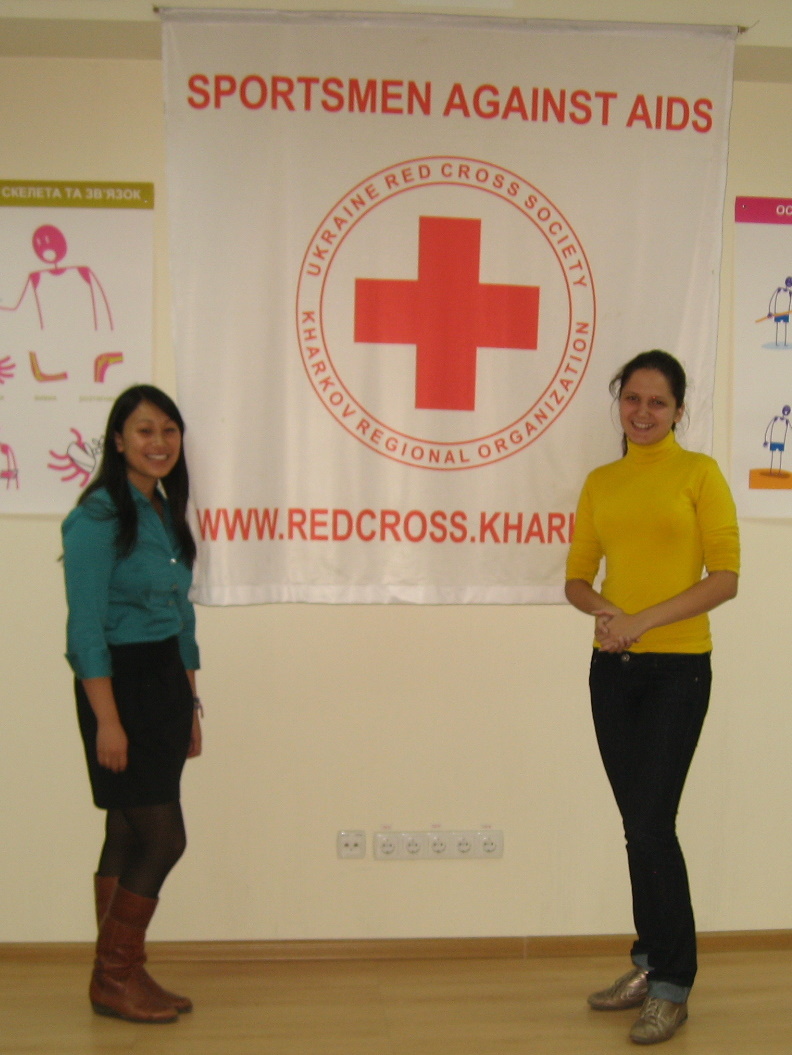
Natalia and I by the Red Cross banner.
What is 527, you may be asking? 527 is the Counter-trafficking and Migrant Advice Hotline developed by the International Organization for Migration (IOM) Mission in Ukraine. The hotline is advertised in all counter-trafficking information campaigns as a helpline providing advice and assistance to victims of trafficking or risk groups. Additionally, it is advertised in information campaigns targeting potential migrants as a helpline which provides information on the current realities and dangers facing Ukrainian migrants abroad, including human trafficking and the consequences of irregular entry and stay in foreign countries. By calling the hotline, Ukrainians can:
  • Be provided with information about how to travel, work, and study abroad safely and legally
  • Find out if the foreign employer offering work is a legitimate and legal source of employment
  • Know what legal, medical, psychological, and professional reintegration help is available to victims of trafficking through IOM and IOM Partner Organizations in Ukraine
 We had 17 participants attend our seminar, all with a very high level of English and therefore we were able to teach this entire seminar in English! 8 other Peace Corps Volunteers from Kharkiv Oblast were able to come and help teach, which was awesome. This made it a great networking opportunity for everyone who attended the seminar - we were able to meet active Ukrainian university students and English teachers, and they were able to meet and get to know us. 
Everyone at the end of the seminar, with our posters advertising 527.
The Ukrainian participants.
The Peace Corps Volunteers.
 We taught a basic overview of human trafficking and included some specific statistics related to the situation in Ukraine. The goal of this seminar was to increase awareness of human trafficking and educate our participants on how to protect themselves from becoming victims of human traffickers. As an icebreaker, we did a blindfolded trust run, where volunteers were asked to run in between two parallel lines of people. Afterwards, we talked about trust and why trust is important in life. We discussed how 57% of traffickers are women, because people are more likely to trust women rather then men.

Natalia running down the hallway.
Next, we asked the participants to guess whether a statement about human trafficking was true or false. They were asked to move to the right side of the room if they thought the statement was true, and to the left if they thought it was false. It was interesting to see both sides defend their views, especially when some of the statments contained statistics that were surprising to the participants. For example, one statement was that "Ukraine is a country of origin and transit – not destination – for trafficking in human beings." This statement is FALSE, because Ukraine is all 3: a country of origin, transit, and destination.
Everyone debating one of the true/false statements.
 We gave a general overview of the Who, What, Where, and How of human trafficking using the powerpoint slides provided by the Gender and Development Working Group of Peace Corps Ukraine. This covered where people are recruited by traffickers, how people may find job opportunities that are not legitimate, what jobs they are offered, who is most at-risk to be trafficked and how victims may escape. The participants were surprised to learn that many people become victims of trafficking when their own family or friends lead them to find opportunities that are not legitimate job or travel offers.
After the overview, the participants were asked to identify the different steps in the human trafficking process.
It was inspiring to see how our presentation impacted the participants - they were able to realize that human trafficking does not only involve women who want to become models and end up being trafficked into the sex industry - absolutely anyone who is interested in traveling or working abroad is also at risk for becoming trafficked. Many of them began to ask questions about how to tell if a job opportunity is legitimate or not, so we explained that there are different factors that contribute to a victim's helplessness (such as having their passport and official documents confiscated by the trafficker). We covered some tips on how to check if a company is legitimate and how to make sure that a job contract is real. To summarize the information covered in the seminar, we divided the participants into smaller groups and provided them with different tasks related to human trafficking. 

The participants then presented their posters to the class. The first group presented an overview of the human trafficking process. The second group brainstormed on how human trafficking can be fought on a personal, community and national level. The third group came up with reasons why people potentially become victims of human trafficking and why women seem to be more at risk than men.

Group 1.
Group 2.

Group 3.
 The last part of our seminar was the action component. To do this, we asked the participants to write information advertising the 527 hotline and about human trafficking on posters. We filmed a short public service announcement using these posters.. you can view our PSA on YouTube here! I apologize about the volume, the microphone on my little Canon PowerShot was clearly not meant for filming videos on busy streets. But we had fun filming the PSA and I hope that you enjoy it. Our video clips from Kharkiv will be submitted to the Gender and Development Working Group of Peace Corps Ukraine and they will compile a PSA with clips from everyone's 527 seminars from all over Ukraine to send to CNN later this fall!

Ed overseeing the poster-making.
Everyone and their posters (sorry its so far away, I wanted to show the scope of the Metalist stadium).
Everyone on the steps of the Sportivna Metro entrance.
We wrapped up the seminar by handing out certificates to all of the participants and giving them the resources to hold such trainings of their own on flash drives. I wish we had time to watch the MTV "Exit" video about human trafficking, but I was happy with all that we were able to accomplish in a short 4 hour seminar. And last but not least, here are the obligatory "funny" photos of the group :)

Showing off big "American" smiles.
Kharkiv Oblast PCVs rock!
More Info about the Counter-trafficking and Migrant Advice Hotline:
Dialing 527 is toll-free from Beeline, life :), Kyivstar and MTS mobile operators in Ukraine.
Dialing 0 800 505 501 is toll-free from landline phones in Ukraine (launched in 2006).
 
;